AI Digest - March 26
What matters to organisational leaders each month

Hi everyone,
As spring has arrived in London, I’ve been enjoying the chance to spend more time outside and less in front of a screen. Whilst undoubtedly a good thing in and of itself, that shift also mirrors the work Tym and I have been focusing on over the last few months: the real-world manifestations of AI, rather than those that exist purely digitally or online. In particular we have been getting more interested in (maybe obsessed by) autonomous - or driverless - vehicles, which are starting to pop up in London ahead of two anticipated service launches later this year.
This has led us to a thesis: when transport becomes a technology rather than a service that requires human input, its cost will fall dramatically, as the cost of other technologies has throughout history. That, in turn, will reshape how we live and organise ourselves, just as tube stops still shape the character of London neighbourhoods and mass car ownership helped drive the emergence of suburbs in the twentieth century. To explore these consequences further, we’ve set up a new organisation, the Institute for Driverless Transport, which will research these consequences, and partner with others looking to do the same. If you’re interested, come along to our kick-off event on 9th April in London, or read Tym’s excellent introduction to why these questions matter and why now is the moment to tackle them.
Enjoy the sun and see you outside
James
If You Only Read One Thing
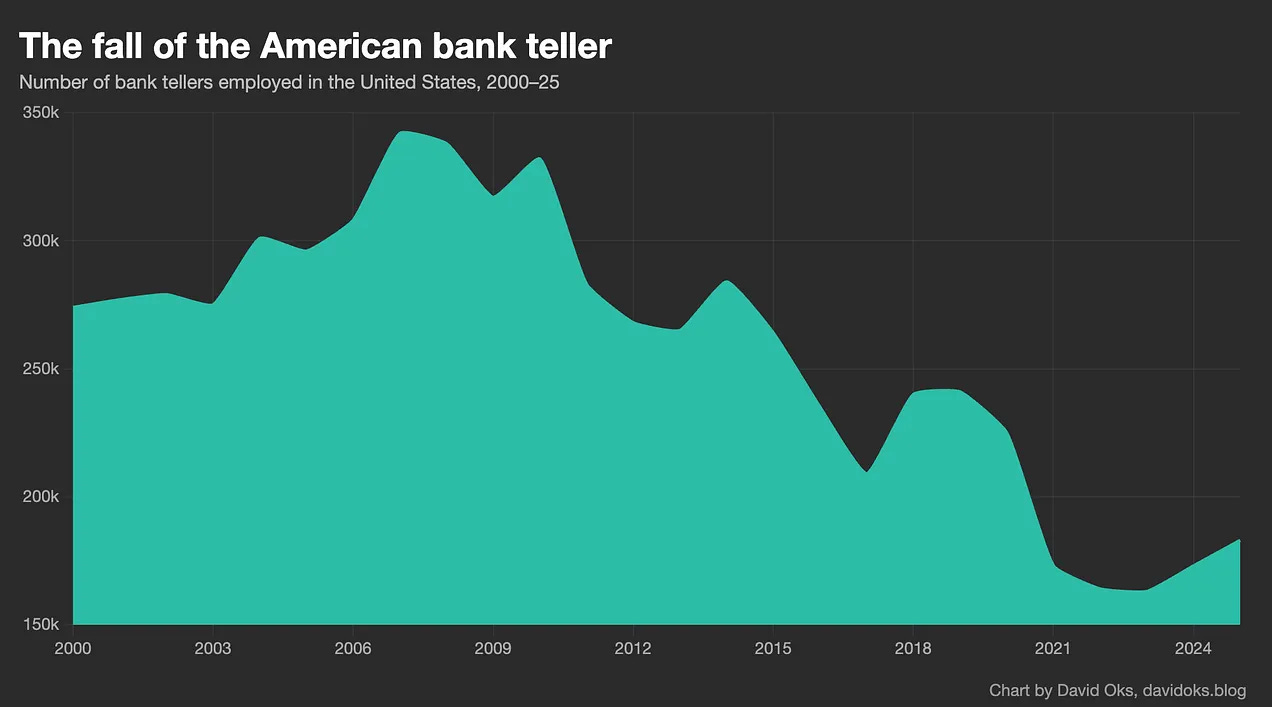
Automated Teller Machines (ATMs) didn’t meaningfully reduce bank jobs, but mobile phones did. Automation that substitutes for existing tasks rarely drives large-scale economic change. A new way of operating, a new paradigm, often does.
The familiar story, at least for those who geek out on the history of technology, is that automation reduced the need for tellers without reducing teller jobs. That was true for a time. ATMs significantly lowered the cost of operating a branch, so banks opened more branches, an example of Jevons paradox, and tellers shifted into sales and customer-facing roles. Several decades later, mobile banking changed the picture. Once the branch stopped being the primary interface, the logic that sustained teller roles fell away and employment fell sharply. The point is not that technology simply learned to do the teller’s job. It is that a new interface removed that category of interaction altogether.
In the short term, most organisations are using AI tools to reshape tasks rather than remove roles, though there is some evidence of reduced hiring. Support staff focus on harder cases while bots handle routine ones. Professionals spend more time on judgement and client work. This can look like a complement to labour, much as ATMs once did. It also lowers the cost of operating existing models, which often leads firms to expand activity rather than shrink headcount. So far, job losses have been limited.
The more important question sits a step further out. What happens when AI changes the interface, not just the task? When customers interact through AI systems rather than through people, or when services are restructured around continuous, automated delivery? Whole layers of work might become unnecessary.
Last week I heard that a very well-funded agent-based AI start-up is ‘terrified’ about its prospects over the next few months. It expects the frontier labs to launch personal agents soon: tools that can handle multiple tasks for a user, removing the need for an agent focused on a single vertical. Are enough businesses asking questions about this kind of strategic threat yet? And are leaders aware not just of the use cases being built, but of the business models emerging around them that could challenge entire sectors? Link: Why the ATM didn’t kill the bank teller.
Contents
If You Only Read One Thing
Paradigm Shifts not substitution
What Is GenAI Good For?
Professional job overview
Increasing work hours
How To Successfully Integrate GenAI With Existing Organisations
Case Study: Making AI use a norm, not an expectation
Automate and Evaluate, rather than Prepare and Plan
Our Recent Work
Introducing the Institute for Driverless Transport
Zooming Out
Economic Disruption
Learning More
Philosophy and Meaning
Research Tips
The Lighter Side
What Is GenAI Good For?
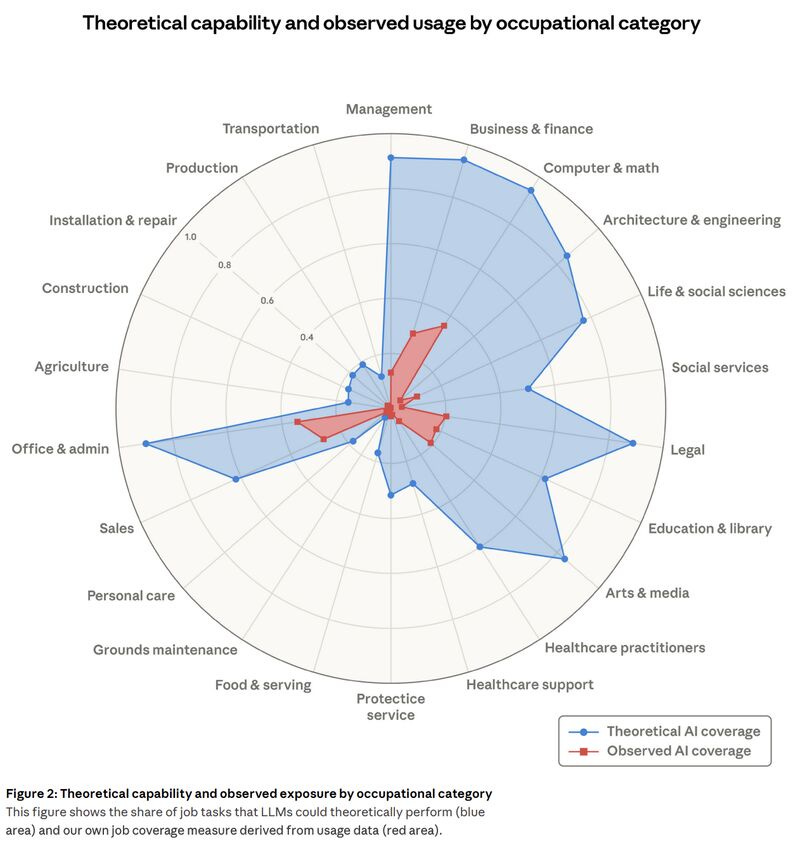
Anthropic’s latest research suggests that professional jobs show both the highest current adoption of AI and the greatest remaining potential. Its analysis highlights a stark gap between theoretical capability and observed usage across sectors, which points to how much AI-enabled work still lies ahead. The difficulty with studies like this is that they reduce whole jobs, or even whole sectors, into discrete tasks that can be assessed for AI capability. Even so, the broad pattern is instructive, and few people would dispute the overall conclusion: much bigger changes are still to come. Report. Discussion.
Professionals can do more with AI, but often that simply means they work more hours overall. The temptation to start a task with an LLM is so strong, and the first step so easy, that an HBR study found AI-powered work spilling into time that previously would have been downtime: walks between meetings, commutes, even the wait by the coffee machine. Much as mobile email intruded on private time and raised expectations of responsiveness, AI tools are eating into time that used to be slack. That may look like a productivity gain, but those quiet moments are often essential for processing and creative thought. This creates a paradox: the very tools meant to automate work and relieve pressure can end up increasing expectations and reducing people’s ability to switch off. Link.
Rapid roundup
As LLM use becomes widespread, language and even patterns of reasoning may become more homogenised. Link.
OpenAI is using AI analysis to catch leakers. Link.
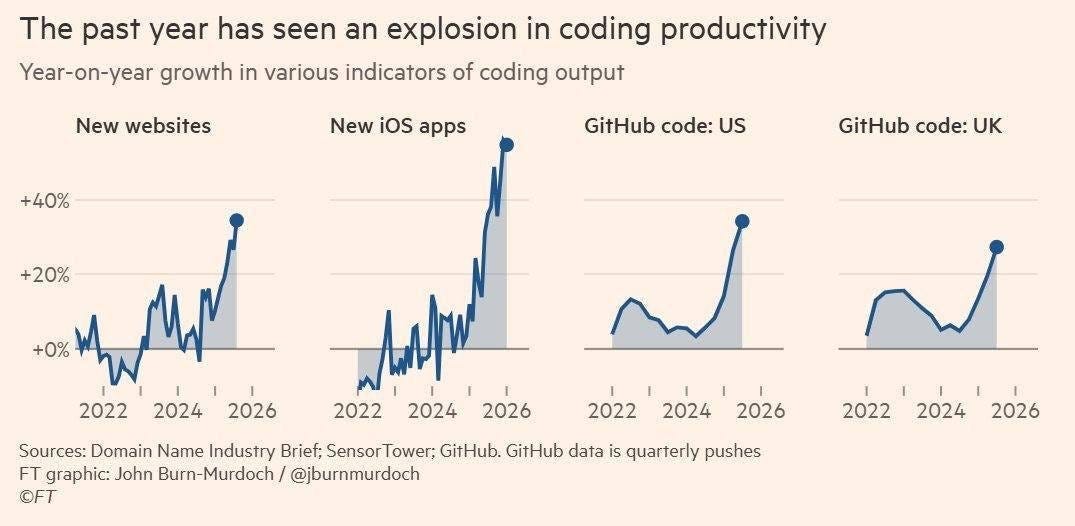
Coding outputs have surged - though a note of caution on the headline that productivity and output measures are not exactly the same. Link (originally FT).
How To Successfully Integrate GenAI With Existing Organisations
Make AI use a shared norm, not just an expectation from leadership. Tech firms are increasingly measuring employees’ use of AI and folding those figures into performance reviews. Like all metrics, those measures are imperfect. But they do create common knowledge: everyone knows that everyone is being asked to use AI more, and that usage should be shared rather than hidden. This mirrors an approach we took in a project last year, where the aim was to move AI use from private experimentation to public, shared iteration and learning. Erez Yoeli, drawing on work with MIT colleagues, identifies three ingredients for creating new norms of this kind: setting clear expectations, making compliance observable, and eliminating plausible deniability. Case Study - Paradigm Junction. Link: OKRs & Norms.
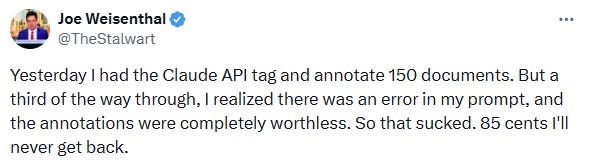
Automated work is now so cheap to produce that the most effective users are changing a long-held instinct: they plan less and evaluate outputs more. The key insight is that agentic tools are still weak at sophisticated decision-making, but they are very cheap at producing drafts and relatively good at checking whether those drafts meet a set of criteria. The practical implication is to ask agents for multiple versions, then have them choose the best one, or compare one another’s work, rather than spending too much time specifying the perfect approach up front. The human role is to make sure the agent has the right information and the right criteria, then let it iterate. A human would lose heart by the second or third attempt. An agent does not. The cost of redoing work is falling towards zero.
Rapid reads.
S4 Capital is moving away from billable hours and towards a subscription model, as AI tools weaken the old link between time spent and value delivered. Link.
Networking is increasingly important, as it becomes harder to distinguish candidates on paper. Link.
Our Recent Work
As ever, February and March have been busy periods for us, so slightly less public writing, but that doesn’t mean we have been slacking. Quite the opposite! We are gearing up behind the scenes for the launch of the Institute for Driverless Transport in a few weeks’ time. Check out Tym’s explanation of why we think more research in this space is necessary, and what we hope to contribute.
Introducing the Institute for Driverless Transport. Link.
Trust and Embodied Technology. Link.
Zooming Out
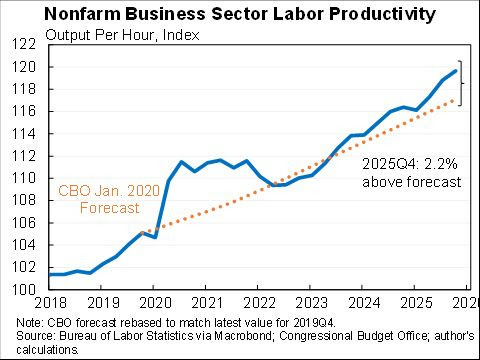
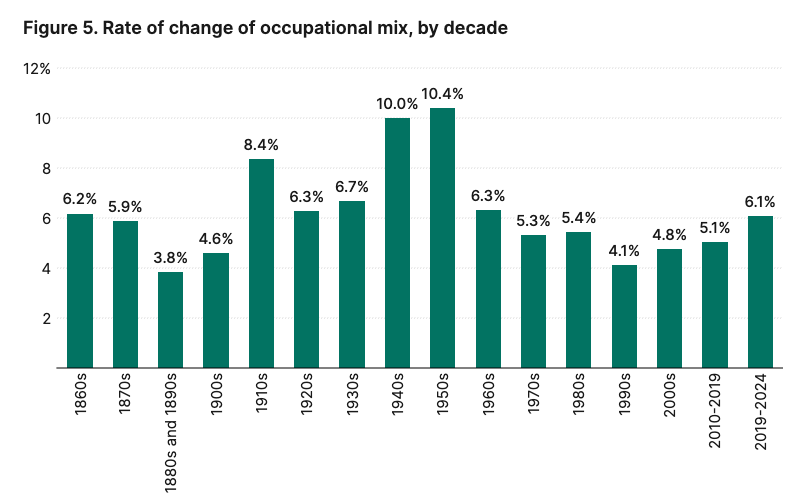
Economic Disruption. One of Paradigm Junction’s founding beliefs is that new technologies, including AI, will significantly disrupt the economy. The difficulty is that these macro debates rarely offer concrete steps for people trying to respond, and they are often less persuasive than stories or direct experience for those who have not yet decided to act. That is why this section sits later in the newsletter. Still, I came across two fascinating charts this month. The first suggests that productivity growth in the US may now have shifted to a consistently higher rate, which is what we would expect if AI adoption is beginning to create real value. The second shows that, despite the economy feeling volatile, the period from 2019 to 2024 saw much smaller changes in the kinds of work people do than the 1940s and 1950s did. The likely conclusion is that the pace of change could increase further from here, even if it already feels fast. If you want to follow these debates more closely, Alex Imas has a wonderful living document on AI’s impact on US productivity. Link.
Learning More
Philosophy and Meaning. I’m sure I’m not the only one finding that conversations about AI quickly veer towards the philosophical. So much of how we evaluate these new capabilities depends on what we think the purpose of our actions is. Some excellent writing is emerging in this space. A few recommendations:
Almost anything from the Cosmos Institute, which tries to fuse philosophy with the work of building new things. In particular, their post on nudges (as in Nudge Theory) and freedom of choice is excellent. Brave New Nudge. Website.
Harvey Lederman’s post on AI and the meaning of life. Link. (thanks to Seb for the share)
Research Life Hacks. Not AI-related, but intensely useful. Do you know what pressing Windows key + V does? I did not until I read this piece from Tym, and it is now one of my most-used shortcuts. Link.
The Lighter Side
A history of technological standards. Told through stories. Link.
The Five Stages of Acceptance. Link.